Burr and Ring Puzzles: Piece Counts, Levels and Move Counts
Two of the oldest mechanical puzzles, and both get harder by a number you can read before you buy.
4 min read
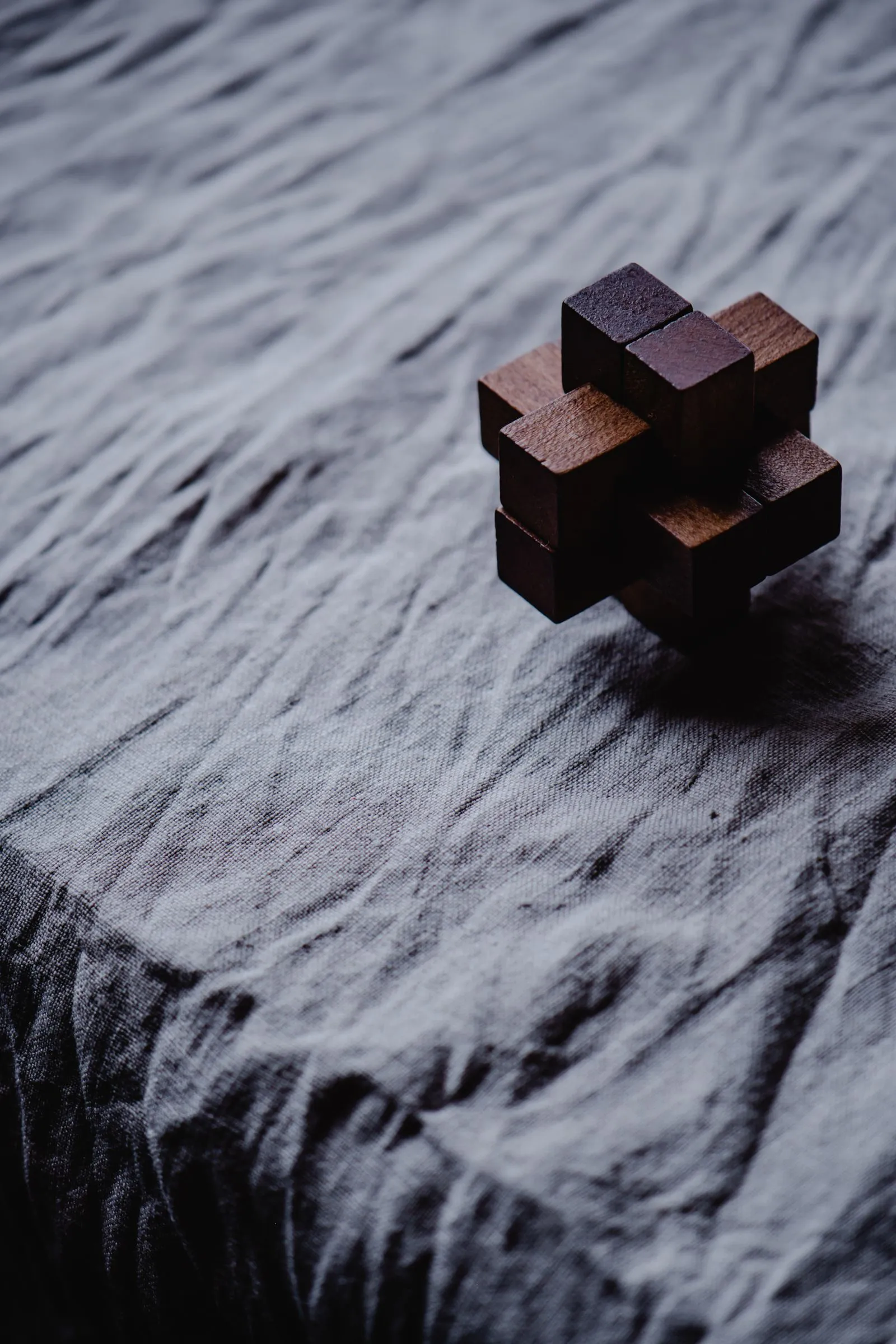
- The classic starter burr
- 6 pieces
- Shortest solve for 5 Chinese rings
- 21 moves
- Shortest solve for 9 Chinese rings
- 341 moves
- Move count for every two rings added
- ~4x
Burr puzzles and ring puzzles are easy to shop for, because each one tells you how hard it is with a plain number. For a burr, it’s the piece count and the level. For a Chinese rings puzzle, it’s the number of rings.
The catch is that the numbers don’t grow the way you’d guess. Going from 6 to 12 pieces is not twice the work, and going from 5 to 9 rings is sixteen times the moves.
Burr puzzles by piece count
A burr is a set of notched sticks that lock together into a symmetrical knot, usually with one “key” piece that has to come out first. Piece count is the first rough guide to difficulty.
| Pieces | What to expect | Who it suits |
|---|---|---|
| 6 | A few minutes to take apart, longer to rebuild | Anyone new to burrs |
| 12 | Far more moves, and pieces that only fit in one order | Someone who has rebuilt a 6-piece from memory |
| 24 | Hours to days, mostly in reassembly | The dedicated collector |
The part people underestimate is the rebuild. Taking a burr apart is the warm-up. Putting it back together, with pieces that all look nearly alike, is the real puzzle. Keep a photo of the solved shape before you start, and lay the pieces out in the order they came out.
We’d start with 6. Every idea in a 12- or 24-piece burr shows up first, in miniature, in a six-piece.
What “level” means on a burr
Burr makers and collectors use a level number that means something specific: the number of moves needed to remove the first piece.
- A level 1 burr has a key piece that slides straight out. The classic solid six-piece burr, with no internal gaps, is level 1.
- A level 5 burr needs five separate moves, sliding different pieces back and forth, before anything comes free.
- High-level burrs sometimes carry a longer code, like 5.2.2, giving the moves needed for the first, second and third pieces.
This is more useful than piece count once you’re past the basics, because a six-piece burr with internal voids (a “holey” burr) can run to a level high enough to stump experienced solvers. Six pieces, level 1 is a starter. Six pieces, level 10 is not.
Interlocking puzzles by piece count
Outside the classic burr shape, interlocking puzzles follow a similar rule of thumb, rough but useful:
| Pieces | Rough effort |
|---|---|
| 2 | A quick, satisfying solve |
| 3–4 | Plan on an evening |
| 6 or more | Can take days |
It’s a guide, not a law. A clever two-piece design can hold someone up longer than a sloppy six-piece. If it’s a gift for someone new to puzzles, start low and let them ask for the harder one.
The Chinese rings puzzle, by ring count
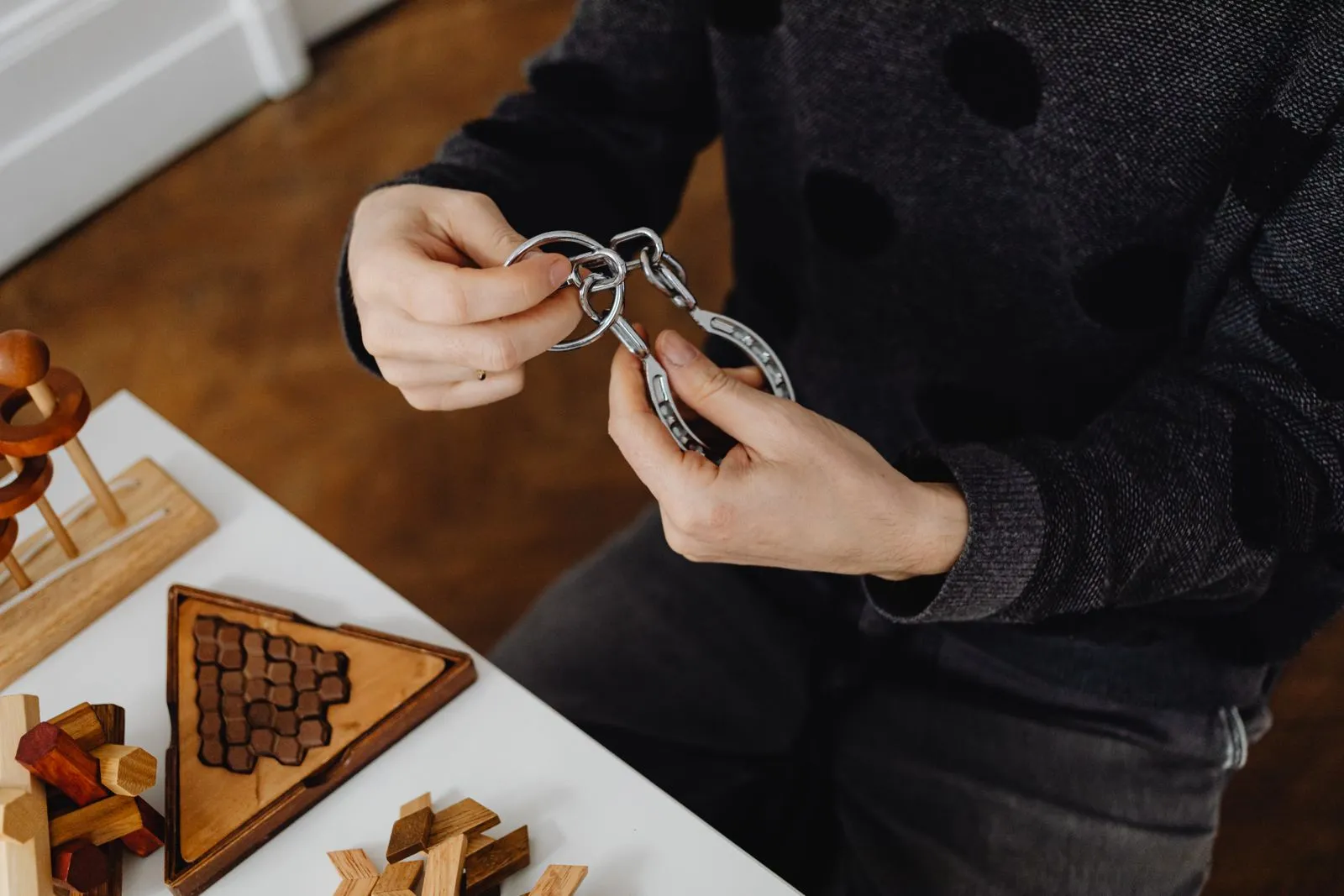
The Chinese rings puzzle is a row of rings on posts, threaded onto a long wire loop. The goal is to get every ring off the loop. It’s one of the oldest mechanical puzzles known, and it runs on two rules:
- The end ring can always be moved on or off the loop.
- Any other ring can move only when the ring right next to it (toward the end) is on the loop, and every ring past that one is off.
That’s it. Two rules, and the count explodes.
| Rings | Minimum single-ring moves |
|---|---|
| 5 | 21 |
| 7 | 85 |
| 9 | 341 |
Every extra ring roughly doubles the count, so every two rings multiply it by about four. The formula, if you want to check: for an odd number of rings n, the minimum is (2^(n+1) − 1) ÷ 3. For an even number, it’s (2^(n+1) − 2) ÷ 3. Plug in 9 and you get 1023 ÷ 3, which is 341.
One caveat on those numbers: some solvers count sliding the first two rings together as a single move, which gives smaller totals. The numbers above count every ring moved on its own.
Why it’s binary underneath
Write each ring as a 1 if it’s on the loop and a 0 if it’s off. Five rings, all on, is 11111. Solved, it’s 00000.
The sequence of positions the puzzle walks through is a Gray code: a way of counting in binary where only one digit changes at each step, exactly like one ring moving at a time. Convert the starting Gray code 11111 back into ordinary binary and you get 10101, which is 21 in decimal. That’s the move count. For nine rings, 111111111 becomes 101010101, which is 341.
This is why the puzzle rewards understanding over fiddling. Once you see the pattern on 5 rings, the same pattern solves 9. It just takes a lot longer, and one slip means backtracking.
Which one to start with
- New to all of this: a six-piece, level 1 burr, or a 5-ring Chinese rings puzzle.
- Solved a few already: a six-piece holey burr at a higher level, or 7 rings.
- Wants a long project: a 12- or 24-piece burr, or 9 rings.
Metal Chinese rings puzzles typically run $10–30. Wooden burrs range from about $10 for a simple six-piece to $50 and up for finely made, high-level designs.
The short version
- Start burrs at 6 pieces, then 12, then 24. Rebuilding is the hard part.
- A burr’s level is the number of moves to remove the first piece.
- Interlocking puzzles: 2 pieces is quick, 3–4 is an evening, 6+ can take days.
- Chinese rings: 21 moves for 5 rings, 85 for 7, 341 for 9.
- The rings follow a binary Gray code. Learn it on 5 and it solves 9.