Metal Puzzle Difficulty Levels: Where to Start and What Level 6 Means
The scale on the box is useful, but only once you know how loosely makers apply it.
5 min read
- The most common difficulty scale on metal puzzles
- 1 to 6
- Where we'd start: an evening, not a weekend
- Level 2–3
- Expect days, sometimes longer
- Level 5–6
- Typical price for a single metal puzzle
- $10–40
Most metal puzzles come with a number on the box, usually from 1 to 6. It’s the single most useful thing printed there, and also the least standardized. One maker’s level 4 can feel like another’s level 2.
So treat the number as a rough band, not a promise. Here’s what the bands usually mean, which kind of puzzle to pick, and how to avoid buying one that ends up in a drawer, bent.
What the 1 to 6 scale usually means
The 1–6 scale is the most common, but some makers use stars out of 5, some use 1 to 10, and some use words like “hard” and “expert”. Within a single maker’s range the order is usually consistent. Across makers it isn’t.
| Level | Rough solve time | Who it suits |
|---|---|---|
| 1 | A few minutes | Kids, or a desk object you’ll solve once |
| 2 | 10–30 minutes | A first metal puzzle |
| 3 | An evening | A first puzzle for someone who likes a fight |
| 4 | A few evenings | Someone who has solved a handful already |
| 5 | Days | Someone with a shelf of solved ones |
| 6 | Days to weeks | The collector who has seen most tricks |
Those times are what owners commonly report, and they swing a lot. A level 3 you happen to see through can fall in five minutes. A level 2 with an idea your brain won’t reach for can sit for a week.
Start at level 2 or 3
Level 1 is too easy to be satisfying for most adults. Level 5 and up is where people give up and look up the answer, which is a worse outcome than never buying it.
Level 2 or 3 is the sweet spot: hard enough that the solve feels earned, short enough that you finish it the same night. If it’s a gift for someone new to puzzles, go 2. If they already do crosswords in pen, go 3.
What 5 and 6 actually mean is not “more fiddly”. It usually means a longer chain of moves, a move that looks wrong, or a mechanism you can’t see. Solving one is less about hand skill and more about patience across several sittings.
Wire, cast or burr: three different kinds of thinking
“Metal puzzle” covers three distinct families. Pick the type before the level.
| Type | What it is | What it tests | Watch for |
|---|---|---|---|
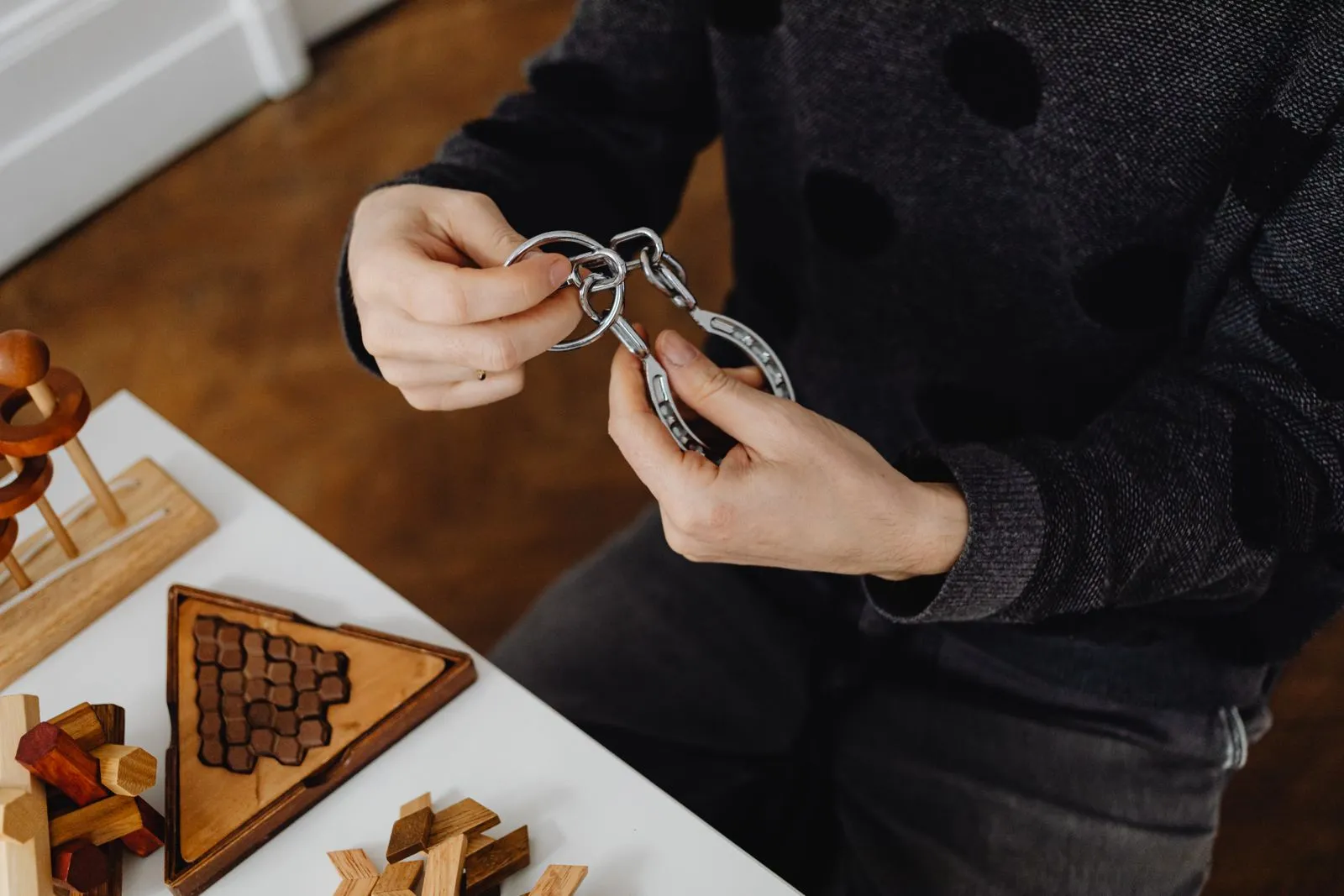
| Wire (disentanglement) | Bent steel wire, usually plated. Free a ring or loop from the rest | Lateral thinking. The answer is rarely the obvious move | Cheap wire bends. Bent wire stays bent |
| Cast | Two or more solid zinc-alloy parts that look fused | Finding a hidden mechanism or a single path out | Rough casting edges that snag |
| Burr | Notched sticks that lock into a 3D knot. Usually wood, sometimes metal | Patient assembly and spatial memory | Reassembly is often harder than taking it apart |
Wire puzzles are the cheapest way in and the easiest to ruin. Cast puzzles are the best-looking on a desk, because the solved state is a solid object. Burrs reward people who like building things. There’s a full guide to burrs and ring puzzles if that’s the direction you’re leaning.
4 things to check before buying a metal puzzle
- A stated difficulty level. No level on the box is a small warning sign. It usually means a generic import with no range to compare against.
- Solid metal, not plated plastic. Weight is the tell. A cast puzzle that sits in one hand should feel heavy for its size. Plated plastic feels hollow and the finish wears through at the contact points.
- A solution in the box. Sealed or printed, it doesn’t matter. Without one, a stuck puzzle stays stuck, and searching for a solution to an unbranded puzzle rarely works.
- A size that sits in one hand. Most good metal puzzles are palm-sized, around 5–8 cm (2–3 in) across. Bigger usually means looser tolerances, not a harder puzzle.
How to solve a wire puzzle without bending it
Wire puzzles never need force. If you’re pushing, you’re doing it wrong, and the wire will remember.
- Never force it. If a loop won’t pass, it isn’t meant to pass there. Back up.
- Slide the loop along, don’t pull it. Most solutions move a loop along the wire’s path, through openings that look too small until the angle is right.
- Note each move so you can reverse it. The route out is usually the route back in, reversed. If you can’t retrace it, you can’t reset it for the next person.
- Start with a two-piece design. Two parts, one ring or loop to free. Three-part wire puzzles add a whole extra layer of sequence.
The honest caveat: some wire puzzles are just poorly made, with openings a millimetre too tight. If a solution in the box says a move works and it clearly doesn’t, the wire may already be out of shape.
Gift ideas for a puzzle solver
If you’re buying for someone who already likes this stuff, four things tend to land:
- A metal disentanglement puzzle at level 3 or 4.
- A six-piece burr, the classic starter burr, in wood or metal.
- A mirror cube, which solves like a 3x3 but scrambles by shape instead of colour.
- A small stand to show off the solve. Solved cast puzzles look good out on a desk.
Pair a puzzle with a stand and it stops being a toy in a drawer and starts being a desk object.
The short version
- The 1–6 scale is common, but makers apply it inconsistently. Compare within a maker.
- Start at level 2 or 3. Level 5–6 means days, not minutes.
- Wire puzzles test lateral thinking, cast puzzles hide a mechanism, burrs reward assembly.
- Check for a level, real metal, a solution in the box and a one-hand size.
- Never force a wire puzzle. Bent wire stays bent.